
Composite materials axis
Project Phase 1
Recycomp
The RecyComp project aims to contribute to the recycling of composite materials through three stages. Recycling, via dismantling and separation using innovative technologies; prevention, by improving the recyclability of composites; and preparation for reuse, by maximizing the number of recycled/recyclable components, minimizing the number of components, and facilitating end-of-life recycling.
Project Phase 2
NEXTGEN
The NEXTGEN project aims to design unique ionic liquid (IL) architectures that will serve as platforms for the development of unique, sustainable, reusable, and (multi)functional networks dedicated to composite applications. Its objective is also to develop chemical recycling methods using green solvents to promote the dissolution and/or depolymerization of thermoset-based composites.
Recycomp – Project phase 1
Excerpt
Project : Recycomp, nouvelle génération de CMO recyclables à partir de matières premières de recyclage : vers une économie circulaire
Isabelle CAPRON, Research director INRAE, BIA
Contact : isabelle.capron@inrae.fr
Alain BOURMAUD, Research engineer, UBS, IRDL
Contact : alain.bourmaud@univ-ubs.fr
Launch date : 01/03/2023
Reference : ANR-22-PERE-0005
Often of fossil origin, most of the components of organic matrix composites (OMC) cannot be easily separated from one another. They are therefore difficult to recycle. OMCs were developed at a time when eco-design and waste recycling were not mandated by legislation. Most composites therefore end up in landfill or are incinerated, undermining their environmental assessment. Waste management in the EU identifies five successive stages, including prevention, preparation for reuse and recycling. The RecyComp project aims to contribute to these three stages.
- Prevention: improve the recyclability of composites by designing them with adhesive solutions derived from sustainable resources that are thermolabile, stimuli-reactive, soluble in green solvents or offer depolymerization capabilities.
- Preparing for reuse: maximizing the number of recycled/recyclable components, minimizing the number of components and facilitating end-of-life recycling.
- Recycling: ensure dismantling and separation using innovative technologies such as subcritical and supercritical solvolysis or solvolysis in twin-screw extruders to produce recycled raw materials (RPMs), and replace difficult-to-recycle matrices with easily recyclable ones.
Keywords: Composites, recycling, recyclability, carbon fibers and natural fibers, sustainable chemistry, circular economy
Tasks
Our researches
CMO recycling and functionalization of recycled fibers
Alain BOURMAUD (IRDL)
This task is to address the recycling of end-of-life composites (historical waste), with solvolysis as the targeted technology, in order to be able to produce recycled raw materials (recycled functional fibers but also monomers/oligomers from the polymer matrix). This is achieved by using green solvents, notably in a twin-screw extruder, under pressure and temperature.
New generation of recyclable composites from recycled raw materials (CMO)
Isabelle CAPRON (BIA)
In this task, the recycled materials from Task 1 are used as secondary raw materials to produce new multi-material composites with improved recyclability, a better carbon footprint and satisfactory performance. Various sub-tasks focus on the design and production, at laboratory scale, of prototypes or multi-layer systems, fully representative of the targeted recyclable composite systems. The quality of interfaces between components and the cohesion between layers are addressed through the development and implementation of specific and original characterization tests.
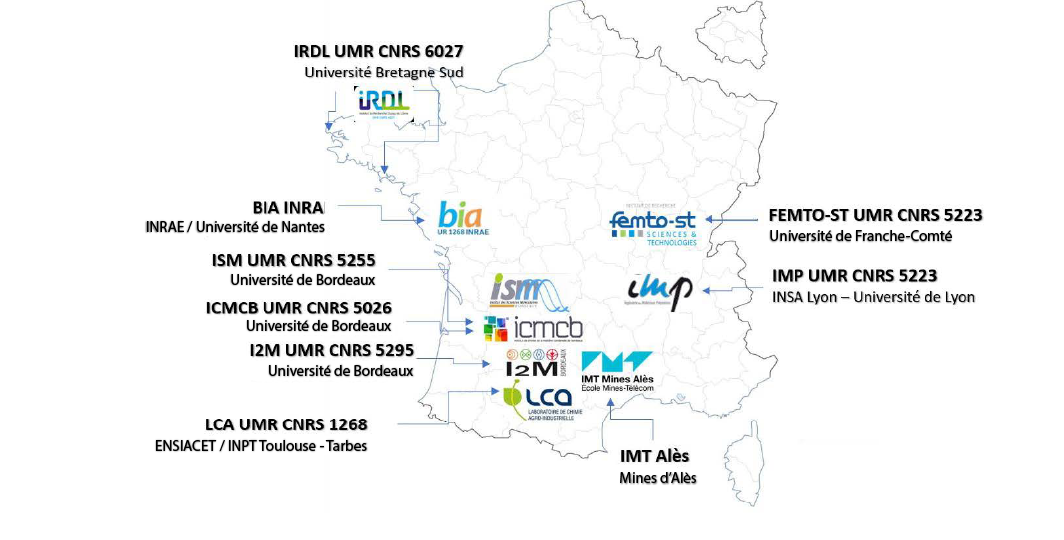
Key-numbers
Laboratories
Researchers
Total budget
Consortium
By contributing to the prevention, preparation for reuse and recycling of used CMOs, the RecyComp project will improve resource recovery, paving the way for the circular economy. Significant effects are expected rapidly for industrial sectors by maximizing recycling and taking into account waste management policies based on “extended producer responsibility” (EPR).
During the RecyComp project, a Life Cycle Sustainability Assessment (LCSA) of CMOs will be carried out, including a Techno-Economic Assessment (TEA) and thus covering environmental, economic and social aspects of sustainability, based on the Life Cycle Assessment (LCA) standardized by the International Organization for Standardization (ISO) and harmonized by the European Commission under the name of Product Environmental Footprint (PEF). At the same time, the economic feasibility of the technological solutions developed will be studied. The RecyComp consortium’s efforts will be aimed at finding the best solutions for a circular economy.
Acquiring knowledge to obtain new generations of recyclable organic matrix composites (OMCs) from recycled raw materials.
Training through research: 4 PhD students, 3 post-docs in 7 different partner laboratories (among the 9 project partners).
NEXTGEN – Project phase 2
Excerpt
Project : The NEXT GENeration of Recyclable, Reusable, and Sustainable Composites
Livi Sébastien, Full professor (IMP Lyon)
Contact : sebastien.livi@insa-lyon.fr
Launching date : 01/11/2025
Référence : ANR-25-PERE-0003
The development of new synthesis methods is essential for designing a new generation of polymers that combine performance and durability while offering sustainable solutions that meet the requirements of the circular economy, i.e., being reusable and recyclable. Therefore, we must propose, through a “functional materials” approach, to develop molecular building blocks that allow the integration of the required functions in the initial synthesis stages.
At the same time, scientists must consider the end of life of these functional materials through the concept of “design for degradation” or “design for recycling.” To meet these challenges, the NEXTGEN project proposes two main strategies: i) Designing unique ionic liquid (IL) architectures that will serve as platforms for the development of unique, sustainable, reusable, and (multi)functional networks dedicated to composite applications, and ii) developing chemical recycling methods using green solvents to promote the dissolution and/or depolymerization of thermoset-based composites.
In conclusion, rich libraries of reusable fiber-reinforced composites combining several functionalities will be implemented using conventional processing methods.
Keywords : Ionic liquids, green solvents, epoxy networks, chemical recycling, fibers, composites, depolymerization
Tasks
Our researches
Synthesis of new monomers and implementation of novel networks
Sébastien Livi
The reactivity of monomers with various hardeners (amine or anhydride) of different molar masses will be studied. By varying the molar masses of these comonomers, different crosslinking densities will be obtained, i.e., different glass transition temperatures of the resulting networks. Particular attention will be paid to analyzing the effect of the presence of introduced ionic species on the kinetics of the reaction and to determining whether it proceeds according to the same mechanisms as those of conventional copolymerization of diglycidyl prepolymers (such as DGEBA) and amines or DGEBA and anhydride.
Study of the fiber-matrix interface
Jannick Duchet-Rumeau and Philippe Evon
In order to consider the application of these new networks as matrices for carbon fiber-based composite materials, the wettability of the different fibers by reactive systems comprising epoxy prepolymer and hardener, as well as the interfacial shear strength (IFSS) of the interface, will be studied.
From the design of polymer networks to their end of life
Cyril Aymonier and Karine Vigier
This task will draw on the various methods developed at laboratory and semi-industrial scale for recycling these materials. This project will contribute to the development of a new dissolution/depolymerization process based on green solvents and the use of supercritical fluids, as well as to the improved recovery and identification of degradation residues.
Circular economy and environmental impacts through life cycle analysis
Sylvestre Njakou-domo
This task will draw on the consortium’s extensive expertise, which has evaluated various recycling routes in terms of environmental impacts. This project adds a new area of work on the impact of the preparation stage of new monomers and the effect of green solvents on their recycling due to their recyclability.
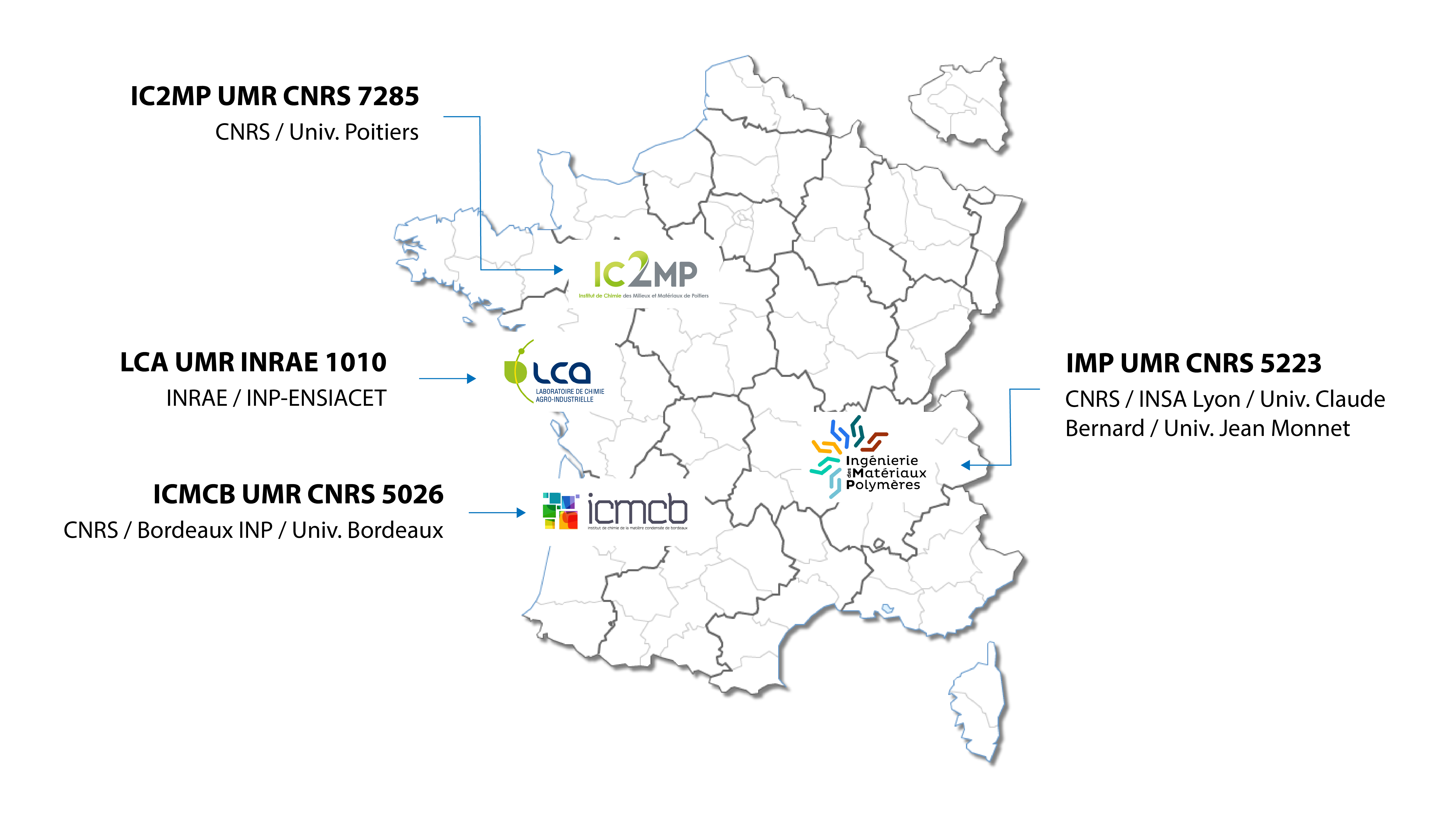
Key-numbers
Laboratories
Researchers
Total budget
Consortium
By contributing to the prevention, preparation for reuse, and recycling of used WEEE, the RecyComp project will improve resource recovery, paving the way for the circular economy. Significant effects are expected quickly for industrial sectors by maximizing recycling and taking into account waste management policies based on “extended producer responsibility” (EPR).
This project will focus on creating a versatile monomer platform for developing a new generation of sustainable, reusable, and/or recyclable polymer materials. It will also focus on designing new chemical recycling methods using green solvents and supercritical fluids to depolymerize/degrade materials in order to control their end of life.
The NEXTGEN project will bring an interdisciplinary aspect that will serve to train a future generation of students: master’s, doctoral, and postdoctoral students who will combine skills in chemistry, polymers, materials, and processes.
Axis news
No news